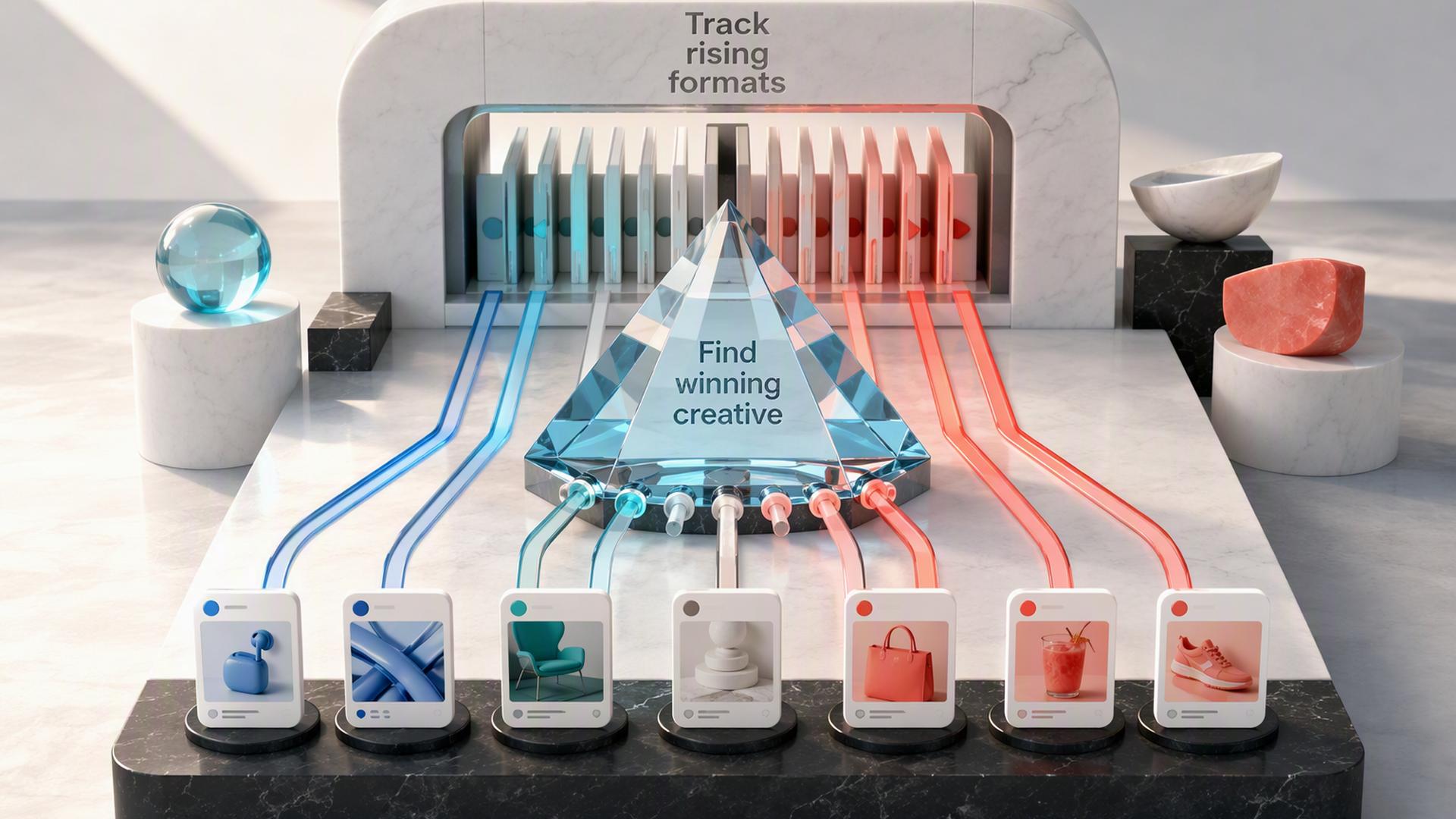
Finding useful Meta ads is easy enough when you already know exactly which advertiser you want to investigate. The harder part is turning scattered competitor ads into repeatable creative research. GetHookd is designed around that broader problem, giving marketers a searchable advertising database alongside competitor intelligence, saved collections, transcription, creative analysis, and AI-assisted production tools.
For advertisers assessing GetHookd for Meta ad discovery and competitive creative research, the strongest part of the platform is how those functions connect. Meta research is not treated as an isolated browsing exercise. A useful ad can become a saved reference, a source for competitor analysis, a transcribed script, or the starting point for a new creative variation. That makes GetHookd particularly relevant to performance marketers, ecommerce brands, agencies, and creative teams that conduct ad research regularly.
Explore Ads Makes Meta Ad Discovery More Practical
Finding Useful Creative Without Starting From Scratch
GetHookd's Explore Ads feature provides access to more than 23 million high-performing advertisements across Facebook, TikTok, and Google. For Meta-focused research, the value is not simply having another place to see Facebook ads. It is having Meta creative available inside a larger research environment where marketers can compare ideas across channels and continue working with the ads they find.
That broader coverage can be useful when a creative concept does not belong to a single platform. A hook working on Facebook may resemble a TikTok format, while an offer appearing in Meta campaigns may also show up in Google advertising. GetHookd makes those connections easier to investigate without requiring every research session to begin from a blank page.
The size of the database is best viewed as a research advantage rather than a guarantee that every displayed campaign will be relevant to a particular brand. Like any large creative library, Explore Ads becomes more useful when marketers enter with a product category, competitor, hook, format, or campaign angle in mind. GetHookd provides the depth; the researcher still benefits from knowing what signals are worth investigating.
Brand Spy Adds Competitive Context
Looking at the Brand Behind the Advertisement
Individual advertisements can be interesting, but competitive research becomes more useful when marketers can see the wider activity surrounding them. GetHookd's Brand Spy is built for this purpose, allowing users to investigate competitors' top ads alongside landing pages, traffic sources, and related information.
This gives teams a better opportunity to identify patterns rather than reacting to a single creative. Repeated offers, product positioning, visual styles, hooks, landing-page choices, and campaign themes can reveal more about how a competitor approaches acquisition. For agencies managing several accounts, that context can also make research more structured because the focus moves from collecting attractive ads to examining the strategy around them.
Brand Spy does not remove the need for interpretation, which is arguably a strength of the research model. Competitor advertising cannot reveal every internal performance metric or media-buying decision, so marketers still need to judge what is relevant to their own audience and economics. GetHookd supplies a useful body of competitive evidence without presenting competitor activity as a substitute for testing.
Saved Ads Turn Discovery Into a Reusable Library
Keeping Strong Creative References Available
A common weakness of ad research is that good examples are often collected temporarily. Campaigns stop running, links disappear, and teams eventually lose the reference that originally inspired a new brief. GetHookd's Save Ads feature allows users to keep selected advertisements even after the original ads go offline and organise them according to factors such as niche, format, or performance.
That makes the platform particularly useful for teams building long-term swipe files. Instead of repeating the same discovery work whenever a campaign is planned, marketers can gradually create a curated collection of hooks, formats, offers, visual treatments, and competitor examples. The benefit is simple, but substantial: research becomes an asset the team can revisit instead of something that disappears after one brainstorming session.
Transcription Makes Video Creative Easier to Study
Breaking Ads Down Into Hooks, Copy, and Calls to Action
Video ads can be difficult to analyse quickly because much of the message is spoken rather than visible in the headline or caption. GetHookd includes ad transcription that converts video content into text, giving marketers a faster way to examine hooks, messaging, calls to action, and the overall structure of a script.
This is particularly useful during Meta creative research, where small differences in opening lines, pacing, product explanations, and calls to action can separate otherwise similar advertisements. A transcription allows teams to compare those elements more deliberately instead of repeatedly replaying individual videos.
The feature also creates a natural bridge between research and production. Once the structure of an effective advertisement has been identified, GetHookd's Video Scripts functionality can use an uploaded ad together with product information to develop new hooks, angles, and scripts. The practical advantage is that inspiration can move into a working creative concept without requiring the team to manually reconstruct every element from scratch.
Creative Tools Extend the Research Workflow
Moving From Competitive Insight to Original Variations
GetHookd goes further than conventional ad discovery by connecting research with creative-generation tools. Clone Ads can take a competitor's ad or a marketer's own creative and produce variations involving elements such as colours, avatars, formats, and styles. The platform also includes Creative Analyzer and AI image-ad capabilities within its credit-based toolset.
The important distinction is that these tools do not make competitive research valuable by themselves. Their usefulness comes from shortening the distance between finding an idea and developing something that can actually be tested. A team can identify an interesting Meta creative, study its structure, save it, transcribe its messaging, and then explore new interpretations within one environment.
That workflow should still be approached as inspiration rather than an invitation to duplicate another advertiser's campaign. Strong creative research usually involves identifying the principle behind an advertisement, such as its hook, framing, offer structure, visual hierarchy, or storytelling format, and adapting that principle to the brand's own positioning. GetHookd provides several tools for doing that efficiently.
Pricing and Credits Suit Different Research Volumes
Choosing a Plan Around How Often the Tools Will Be Used
GetHookd currently offers several subscription levels, beginning with a Starter plan at $29 per month when billed monthly. The Pro plan is listed at $49 per month, Team at $79 per month, and Agency at $129 per month. Annual billing lowers the equivalent monthly cost, and the company offers a seven-day free trial.
Plans combine seats with credits that can be used for functionality including Brand Spy, transcription, AI scripts, AI image ads, and Creative Analyzer. The Starter plan includes 50 monthly credits and one seat, while higher tiers increase both credit allowances and team access. This makes the pricing structure fairly straightforward for users who can estimate how heavily they expect to use the more advanced research and production functions.
The main consideration is therefore less about whether the platform includes enough functionality and more about matching the subscription to the workflow. Someone conducting occasional ad research may use GetHookd differently from an agency researching competitors and creating variations across several accounts every week. The credit system makes usage visible, while the range of tiers gives heavier users room to scale without requiring every customer to start with an agency-level package.
GetHookd Works Best as a Creative Intelligence Workspace
Where the Platform Fits Into a Marketing Stack
GetHookd is especially well suited to marketers who want competitive intelligence and creative development to sit closer together. Meta advertisers can research existing campaigns, examine competitors through Brand Spy, save useful references, study video scripts, and continue into creative ideation without relying on an entirely separate set of tools for each stage.
It is still important to distinguish creative intelligence from first-party campaign analytics. GetHookd helps marketers understand external advertising patterns and generate new directions, while actual decisions about budget allocation, conversion performance, audience quality, and profitability should continue to come from the advertiser's own Meta account and business data. Used in that role, GetHookd complements campaign analytics rather than attempting to replace them.